Showing posts with label reconstruction. Show all posts

Saturday, January 19, 2013

A journalist ventures back to a troubled, seductive Haiti

01/18/2013 
A journalist ventures back to a troubled, seductive Haiti

By Michael Deibert

The Huffington Post


(Read the original article here)

In 1996, freshly graduated from university, I went into a local bookstore in Pennsylvania and picked up a volume that ultimately changed my life.

The book was The Rainy Season: Haiti Since Duvalier by journalist Amy Wilentz. Published seven years earlier, it was a chronicle of the fall and aftermath of 29 year Duvalier family dictatorship in that tumultuous Caribbean nation. The writing was crisp and insightful, the political and social drama it depicted Shakespearean, the long struggle it described of a nation trying to form a responsive democracy in the face of local tyrants and international meddling was Sisyphean. Within a year I was in Haiti, a relationship that continues to this day.

Now, 23 years after The Rainy Season, Wilentz, a professor at the University of California at Irvine, returns to the Magic Island with her new volume, Farewell, Fred Voodoo: A Letter from Haiti.

Much has transpired since The Rainy Season, not least of all the apocalyptic January 2010 earthquake that leveled much of the capital and surrounding towns, killing tens of thousands of people. Haiti's two-time president Jean-Bertrand Aristide, a figure who, as much as anything, Wilentz's first book helped solidify in the international imagination, was overthrown not once but twice, in 1991 and in 2004, in circumstances that couldn't have been more different. A United Nations peacekeeping mission, largely unloved and convincingly linked to a strain of cholera that has killed over 7,000 people, has been on the ground for nearly a decade.

Unlike many commentators on Haiti, Wilentz genuinely likes and is stimulated by the Haitians themselves, and, in between despairing observations, in both The Rainy Season and Farewell, Fred Voodoo, she manages to capture the beauty of Haiti, physical and spiritual, something that foreigners writing about the place rarely do.

But despairing and pessimistic would indeed seem to be the most apt adjectives for the book's take on Haiti's post-earthquake landscape.

After Wilentz adroitly points out that what was often commented upon as Haitian "resilience" after the earthquake was in fact more likely post-traumatic shock, she goes on to conclude that "misery in Haiti today is a job creator for the white man" and that "the aid superstructure in Haiti...has created exactly the circumstances in which it becomes indispensable." Acidly and perceptively, she compares the thousands of aid workers, journalists and others who descended on Haiti after the quake as the equivalent of loup garous, the parasitic werewolves of Haitian folk legend.

She wonders why, if in the earthquake's aftermath the international community was able respond so quickly to so many chronic needs in Haiti as access to clean water, these problems could not be addressed before. As she did in The Rainy Season, Wilentz also pays tribute to the political significance of vodou, Haiti's syncretic religion that is too often ignored or caricatured.

Some of the book's anecdotes - from a hapless Haitian-American couple trying to buy land to a relentlessly self-promoting American journalist to a rather overdone portrait of an American doctor - run a bit long, but Wilentz can be darkly humorous in the margins. One American adventurer is described as having "liked to drink a quart of whiskey a day and to chain women up...[His] marriages did not last long." When Wilentz delves into the details of the 2010 privatization of Haiti's state telephone company, Teleco, and the state's torturous relations with the communications giant Digicel and its Irish chairman Denis O'Brien, the book is revelatory.

The book's major shortcoming is an unwillingness to address directly the tangled legacy of Aristide, a man whom Wilentz, as much as any writer, helped to bring to international prominence.

Though in one passage she tellingly recalls Aristide truculently complaining that hundreds of checks sent from abroad to fund his "projects" were not large enough - "not worth cashing," in fact - Wilentz's rather forgiving view gives rather short shrift to voluminous evidence that complicates any benign picture of the former president.

When Wilentz writes about Aristide's paternal relationship with street boys when he was a priest, she omits the far darker turn that relationship eventually took, with Aristide's political party and government helping to organize youth gangs as a bludgeon to use against his political opponents. Those looking for an examination of why virtually the entire top command of Aristide's police force and the upper management of Teleco during his tenure subsequently ended up in prison for drug trafficking and corruption offenses will look in vain, as will those looking for an accounting of the government's often horrific collective punishment against its rivals.

Wilentz herself treads very close to an apt, though inexact, parable for Aristide's rise and fall, when she accurately concludes that, culturally and politically, Haiti most closely resembles "French West Africa."

Like Aristide, Côte d'Ivoire's former president Laurent Gbagbo was once viewed as a champion of democracy as he led opposition to the long dictatorship of Félix Houphouët-Boigny. And like Aristide, once in power Gbagbo began to mimic in every particular the very worst and most anti-democratic tendencies of those he once railed against. After serving as president from 2001 until 2011, Gbagbo was extradited to the International Criminal Court in the Hague to be tried for crimes against humanity. Aristide returned to Haiti from exile in 2011. He is currently being sued by account holders ruined in a government-endorsed cooperative scheme during his administration and some of those same street children he once allegedly championed.

Writing in a marriage of memoir and critique, Wilentz's true strength is in honestly documenting the Haiti that foreigners who visit there construct for themselves, concluding that, despite its image of misery, for the misfits, idealists, adventurers and opportunists that wash up on its shores, Haiti is "a welcoming, accepting place where you can be yourself."

A hard sell, perhaps, to those who know only the Haiti of violence and calamity, but a sentiment that rings very - almost painfully - true to those who have seen and been moved by one of the nation's many other faces. Farewell, Fred Voodoo shows us a few of them and hopefully will provoke readers to look still further.

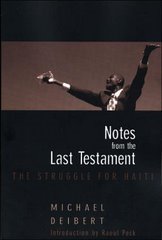
Michael Deibert is the author of Notes from the Last Testament: The Struggle for Haiti (Seven Stories Press) and the forthcoming Democratic Republic of Congo: Between Hope and Despair (Zed Books).

Monday, January 14, 2013

Reporter depicts events surrounding Haiti earthquake

Reporter depicts events surrounding Haiti earthquake

By Michael Deibert

The Miami Herald

The Big Truck That Went By: How the World Came to Save Haiti and Left Behind a Disaster

Jonathan M. Katz, Palgrave Macmillan, 320 pages, $26.00

(Please read the original article here)

Jonathan M. Katz’s new book about the aftermath of Haiti’s devastating earthquake in 2010 is fascinating but frustrating. An Associated Press reporter who lived in the country for two years before the disaster, Katz brings an on-the-ground flavor to his depiction of events that is more vivid than those in the more ponderous tomes published in the wake of the calamity.

Katz’s description of the day of the earthquake — a day that could have killed him — is wrenching and terrifying, and his descriptions of the often-callous diplomacy in its aftermath are bitterly convincing. His minute dissection of the failure of most of the promised aid and the misdirection of much of what did arrive is a valuable contribution to understanding how the international community should respond to such crises in the future. Even more chilling is his account of the indifference and subsequent obfuscation of the United Nations mission in Haiti and the fact that its troops introduced a cholera epidemic to the country that killed at least 7,000 people.

But Katz’s sharp lens turns fuzzier when he writes about the Haitians themselves. Early on, he states that he relied on his fixer — a driver/translator/guide — “for everything” during his time in Haiti, and so the account we see is what that fixer showed him, not the account of a journalist venturing forth to immerse himself in the country on its own terms. That’s a pity; Katz is a talented writer, and surely he had interesting thoughts about the subject. His window into Haiti’s byzantine political culture also seems to come from a single source, a former government minister who cannot on his own puzzle out the entire riddle of Haiti’s venomous political landscape.

Katz’s desire to see straight lines where tortuous twists and turns lie means that he tends to oversimplify complex situations. This habit become most problematic when he tries to assess Haiti’s history before he got there. Puzzlingly, nowhere in The Big Truck That Went By does he mention one of the events that probably more than any other destroyed Haiti’s rural agriculture and accelerated the urban migration to the destined-to-be-wrecked capital: a U.S.- Canadian funded program that, in the 1980s, succeeded in destroying 1.2 million of the Kreyol pigs that formed the backbone of the peasant economy.

Legislative elections in 2000 that saw journalists and opposition politicians murdered and their homes and party headquarters burned down are said to have suffered from “alleged fraud.” The chronology of the late-2003/early-2004 armed rebellion that (along with massive street demonstrations) would eventually bring down the government of then-President Jean-Bertrand Aristide is also fudged, with Katz blaming the action on a “small band of well-armed rebels.” In fact, the movement began among a street gang of former loyalists in the northern city of Gonaives, incensed in their belief that Aristide had murdered their chieftain.

Even given Katz’s admirable doggedness as a journalist, there doesn’t seem to be a great deal of love for Haiti in this book. Not for its mist-shrouded mountains, its azure coastal waters, the seductive gingerbread architecture that still rears up unexpectedly in its provincial towns or — with the exception of his fixer and the story of an earthquake-displaced family he movingly chronicles — the Haitians themselves. The Haitians in fact seem to rather irritate Katz, constantly bending his ear with unwanted conversations to the point where he can “hardly ask for directions.” At one moment, he admits that, despite having lived in the country for almost three years, he had rarely “let his guard down” with Haitians, which translates into a lack of intimacy with and insight about the people at the heart of the story.

Katz is a writer of considerable talent, with an often mordant and memorable turn of phrase. Had he schooled himself more thoroughly in Haiti’s history and immersed himself to a greater extent among its people before setting pen to paper, he could have produced a knockout of a book. Despite its many virtues, ultimately The Big Truck That Went By represents another example of what Katz himself exposes so thoroughly of the international community’s involvement with Haiti: Something of a missed opportunity.


Michael Deibert is the author of Notes from the Last Testament: The Struggle for Haiti (Seven Stories Press) and the forthcoming Democratic Republic of Congo: Between Hope and Despair (Zed Books).
Sunday, July 25, 2010

La reconstruction n’est pas viable sans une décentralisation véritable

Haïti/Post-séisme : La reconstruction n’est pas viable sans une décentralisation véritable

samedi 24 juillet 2010


par Ronald Colbert

(Read the original article here)

Jean Rabel (Haïti), 24 juillet 2010 [AlterPresse] --- Les paysans, qui ont accueilli avec beaucoup de solidarité de nombreuses personnes en provenance de Port-au-Prince, après le séisme du 12 janvier 2010, ont leur mot à dire et leurs propres propositions sur le processus de reconstruction nationale annoncé.

C’est l’un des points forts d’une conférence-débat, déroulée sur la cour de l’école Dominique Savio à Jean Rabel dans l’après-midi du jeudi 22 juillet 2010, à la veille du 23 e anniversaire du massacre des paysans dans cette ville, située à environ 250 kilomètres au nord-ouest de la capitale Port-au-Prince, selon les informations obtenues par l’agence en ligne AlterPresse.

Des centaines de participantes et participants à la conférence-débat ont exprimé des desiderata en faveur du remembrement et d’une relance effective de l’agriculture régionale et nationale, notamment à partir des sections communales.

Se référant à l’article 36 de la Constitution du 29 mars 1987, ils demandent aux autorités nationales de légaliser l’occupation, par les paysans, de plus de 3 mille carreaux de terre de l’Etat, qui se trouvaient entre les mains de grandons (potentats) qui détiennent encore des propriétés de l’Etat, inexploitées à Jean Rabel.

C’est dans ce contexte que l’organisation Tèt Kole ti peyizan ayisyen (union des petits paysans haïtiens) a fait choix, de concert avec la municipalité de Jean Rabel, d’une portion de terre qui devra être appropriée pour l’implantation d’une forêt communale et d’une exploitation agricole (modèle) dans la zone, en attendant la formalisation de conditions administratives avec la direction générale des impôts (Dgi).

En plus de tracteurs et de semences locales, ils exigent des dispositions techniques pour l’utilisation des eaux des Trois rivières dans l’irrigation, principalement des terres du Bas Nord-Ouest (Jean Rabel, Baie de Henne, etc.). Tout en préconisant une réforme agraire pertinente, ils se prononcent contre la poursuite de la distribution des semences hybrides (fournies au ministère haïtien de l’agriculture par la transnationale américaine) qu’ils qualifient de “cadeau empoisonné pour l’agriculture nationale”.

Les participantes et participants à la conférnce-débat, à l’occasion du 23 e anniversaire du massacre de paysans à Jean Rabel, réclament également la mise en place de structures scolaires adéquates (avec un corps professoral adapté), de struc tures universitaires régionales, de structures sanitaires valables (avec une disponibilité de médicaments non expirés).

A leur avis, la construction de certains édifices scolaires ainsi que le lancement (le 10 juin 2010) des travaux d’érection d’un pont stratégique à jeter sur les Trois Rivières durant 11 mois (jusqu’en mai 2011) ne sont que des gouttes d’eau dans l’ensemble des actions concrètes à entreprendre dans le département géographique du Nord-Ouest, spécialement à Jean Rabel.
Interrogés par AlterPresse, plusieurs participants estiment n’avoir encore rien constaté de concret dans le processus de reconstruction déclaré, malgré les ressources financières importantes déjà engagées en ce sens.

Les intervenants à la conférence-débat du 22 juillet 2010, en prélude au 23 e anniversaire du massacre de paysans de Jean Rabel, étaient Ollery Saint-Louis du groupe d’appui technique et d’action pédagogique (Gatap), Klébert Duval, ancien membre de l’équipe missionnaire de Jean Rabel et Patrick Saintil, secrétaire général du Fonds international pour le développement économique et social (Fides-Haïti).

« Nous allons œuvrer en vue d’entamer les actions de reconstruction nationale à partir des sections communales (par des initiatives dans les bassins versants) », a promis, le 23 juillet 2010, Raynald Clérismé (ex-fondateur de l’organisation Tèt Kole ti peyizan ayisyen durant les années 1980), membre d’une commission de reconstruction gouvernementale, qui a été ministre des affaires étrangères (2006 – 2008) au début du deuxième mandat du président René Garcia Préval.

Saturday, July 3, 2010

On the Ground in Haiti

Friday, July 02, 2010

On the Ground in Haiti

By John A. Carroll, M.D.

(Read the original posting here)

My wife Maria and I worked in Haiti during part of the months of May and June. We stayed in a guesthouse-orphanage just outside of Port-au-Prince.

A lady named Yolande lived right across the street from us.

Yolande is 78 years old and lives under a blue tarpaulin which encloses a small pup tent inside.

During the earthquake on January 12 her shack, which was located several miles away, was so damaged that she had to move out. Yolande suffered some leg injuries at the time of the quake and still has one lower leg wrapped in a rag. But Yolande smiled and told me that her legs were "much better".

One afternoon shortly after we arrived, I entered an opening in Yolande's blue tarp. The stifling heat, humidity, mosquitoes, and flies were overwhelming.

The tarp was fastened to thin wooden poles and tied above with shoe laces and other fragments of cloth.

Yolande's family brings her rice and vegetables when they can and she cooks in a metal bowl over pieces of charcoal.

I found Yolande to be a practical and pleasant woman. She did not complain about her living arrangements and even said that Americans are the most charitable people in the world. I sure did not feel that way right then as I hurried out from under the tarp so I could get a breath of cooler air in the street.

During this time of the year in Haiti, the rain comes in torrents in the late afternoon or evening, and now this rain seeps through Yolande's tarp and leaks into her tent. So on top of roasting, Yolande and her family are wet much of the time too.

These hardships are not isolated to Yolande.

Haiti has an estimated 9 million people with one third of the population living in the capital, Port-au-Prince. In this city there are over one thousand tent cities, and an estimated 1.5 million people are still homeless five months after the quake. Many people told me that they are simply too afraid to move back inside of their houses. If their houses are still standing, the walls may have been fissure (cracked) and people fear they will collapse on top of them.

Several miles from us downtown Port-au-Prince looks like a nuclear bomb struck it. The once beautiful Haitian National Palace is collapsed and the majority of nearby Haitian government ministry buildings downtown were destroyed in the 47 second earthquake. Haiti's tax building is pancaked just across from the Palace with its director's body and many employees still inside under tons of concrete.

A densely populated tent city now sits in front of the vacant Palace in Port-au-Prince's largest square called Champs de Mars. A young man who identified himself as Carlos told me some of their problems after I walked through his section of the tent city. Carlos seemed fatalistic and did not see any end in sight to their misery.

Rape is common in Port-au-Prince's tent cities and seldom gets reported. Poor women in tent cities have no rights.

Fountains and small decorative pools in Champs de Mar have turned into large toilets filled with stagnant sewage. Kids play nearby with their family's tent abutting these toxic cesspools. Sewage drainage and treatment facilities are more or less nonexistent.

In the chaotic months following the quake, millions of dollars flowed into Haiti from generous people all over the world. (One out of two American households gave to the Haitian relief efforts.)

And five billion more dollars from the international community has been pledged to Haiti over the next two years. Bill Clinton who is UN Special Envoy to Haiti. Recently Mr. Clinton along with Haitian officials have been in charge of the Interim Haiti Reconstruction Commission. One of the objectives of this Commission is to allocate these funds to ensure that the money is used in a transparent fashion for Haiti's post earthquake reconstruction.

Mr. Clinton and Haiti's Prime Minister Bellerive announced the Commission's first approved spending projects:

- $45 million from Brazil and Norway in direct funds for the Haitian government, closing a quarter of its estimated $170 million budget shortfall.

- $1 million from the Clinton Foundation for buildings that can be used as storm shelters in the quake-ravaged towns of Leogane and Jacmel, which are often in the path of Atlantic hurricanes.

- A $20 million fund to provide loans to small- and medium-sized Haitian businesses.

But despite international pledges of some $5 billion over two years at the United Nations donors' conference for Haiti in March, only a fraction has actually been delivered - just $40 million from Brazil.

Even though other pledges are supposed to be delivered soon, I spoke to no Haitians during our entire time in Haiti who trusts that the money will be spent properly. People that I spoke with don't really trust Mr. Clinton any more than they do their own fragmented and dysfunctional government. Many are very angry with Haitian President Preval for his perceived lack of leadership and poor communication through Haiti's largest crisis in its history. They also feel he is cuddling up to international powers for business interests that will exclude the majority of poor Haitians.

And why should 9 million poor Haitians trust any one? They and their ancestors have been on the short end of the stick since Haiti was founded as a Republic more than 200 years ago. The corrupt Haitian state is considered to be a fact of life... not unlike corrupt Illinois politics.

So what do "we" do with hundreds of thousands of displaced and homeless Haitian people? Although Haitians are a tough lot, they are not as resilient as our defense mechanisms would like us to believe. And on top of this earthquake which was "biblical" in size, the U.S. National Oceanic and Atmospheric Administration has predicted a terrible tropical storm season coming Haiti's way in several months.

But so far (as of this writing) the Haitian government has relocated only about 7,000vulnerable people to two safer camps. The relocation is slow because the crippled government doesn't have enough money to complete a job that includes not just setting up new tents, but providing work, schools and services.

First of all, should the tent cities continue to exist? Are they good enough?

No. These places are inhuman and horrible. Lack of food and water, lack of security, and the rain are a few reasons.

And the rain is quickly bringing more problems.

Malaria and typhoid fever were everyday occurrences in the area of the city where I was working. Stagnant dirty puddles of water are everywhere and are good breeding grounds for mosquitoes who will carry disease. I saw a teen-aged boy scooping up water in his hands drinking from a puddle in the road. Medical and public health interventions will not help the majority of Haitians unless their dangerous living environment is changed.

Also, heavy rains tempt unstable hillsides to unleash their mud. And serious flooding and mudslides could endanger not only Haitians but relief workers also.

Port-au-Prince, before the earthquake could have accommodated 300,000 people, not three million people. There has been decades of urban decay. This city is doomed right now unless a paradigm shift in thinking takes place.

We need to be honest and understand that many people are dying now and are still going to die no matter what is done. I saw children starving in front of me. I often wondered what good was my stethoscope in times like this.

So what needs to happen? What interventions will minimize the final death count? How can Haiti's problems be prioritized and triaged appropriately? What can be done to give some dignity to the life of over one million displaced Haitians? How do we stop the violence aimed at Haitian society's unfortunate losers?

Haitians tell me they want jobs. Who would have thought?

Jobs earn them money to repair their lives and their family's lives. Jobs allow one parent to stay at home during the day and take care of their babies and toddlers. Kids suffer alot mentally and physically when they are alone or being watched by a neighbor who is already swamped with problems. Children are literally down in the dirt and sewage and their chances for survival diminish without a parent home.

Mother's can breastfeed if they are home. And when mother's breastfeed, they save money because they do not need to purchase milk. And if they purchase powdered milk, they may accidentally prepare it with dirty water which can sicken their children.

With the billions of dollars that hopefully will come to Haiti, big firms with heavy equipment should be hired. Skillful urban planners from all over the world need to work with the Haitian government.

And most importantly poor Haitians need to be hired.

Hundreds of thousands of young, strong Haitian men and women that live in the capital would jump at the chance for a job. Hire them and pay them fairly so they can feed their families while they make a new and better Haiti. The billions of dollars of international pledges need to go for displaced Haitians while they perform the back breaking reconstruction of Haiti.

Pay Haitians in tent cities to repair or rebuild their own homes--the structures where they were living pre earthquake. Or pay the man that rents the home to these people. And these homes need to be earthquake proof homes using Western building codes. Earthquakes don't kill people, bad buildings do.

The huge mounds of rubble on the Port-au-Prince streets needs to be cleared so the streets can be navigated by cars and big equipment.

The traffic jams in the capital now slow progress for everyone.

Many people have returned to their neighborhoods after inspections found their homes safe, but often return to the tent camps when word of aid distribution spreads. So food and water distribution needs to be local--- brought to people in their neighborhoods as their homes are rebuilt.

Port-au-Prince needs to be decentralized. The earthquake negatively influenced 80% of Haiti's economy because PAP was and is the hub of the country. Now the hub is critically ill. The capital is built over fault lines and this all could happen again. Three million miserable people living on top of each other need to be spread back out to Haiti's provinces.

But for people to move to the Haitian countryside or smaller cities outside of PAP, there has to be jobs, family members with adequate housing that can accept their homeless relatives, and some basic services like schools, roads, water, electricity, and medical care.

Trees need to be planted and gardens started in these communities. Listening to Haitian grass roots organizations and the Haitian farmer is very important. These people know what they need to stay alive.

The local Haitian community in the province needs to be involved in all decision points.

For­eign aid that flowed into Haiti after the quake has hurt the Haitian farmers. Most of the peo­ple in Haiti's central plateau (L'Artibonite) earn their liv­ing by grow­ing and sell­ing rice, Haiti’s sta­ple food. But the influx of for­eign food aid has meant that many Haitians can now get rice for free. As a result, the price of rice grown in Haiti has plummeted and the Haitian farmer finds himself in more trouble.

Several months ago even Mr. Clinton was quoted as saying, "...we made a devil's bargain" when he was President. He publicly apologized for forcing Haiti to drop tariffs on imported, subsidized US rice. His policy hurt Haitian rice farming and, as reported by Kim Ives, "seriously damaged Haiti's ability to be self sufficient".

And let us not forget that Haiti, believe it or not, is in the digital age. The Haitian people in the countryside have cell phones and access to the Internet. Many Haitians are adept at using both. This means that they still communicate with Haitian relatives, the diaspora, overseas.

Haiti's diaspora has sent back billions of dollars over the past few decades to needy Haitian relatives, but this obviously has not been enough. The diaspora need to physically come back to Haiti and revitalize Haiti's industrial sector. But they won't come back and invest in Haiti unless than can do so safely. Most diaspora tell me they fear for their personal safety in Haiti. Security everywhere needs to be improved. And the economic climate for joint business ventures, to stimulate Haiti's diaspora to invest in Haiti, has to be improved by the Haitian government.

In conclusion, Haiti was a severely damaged country before the January earthquake and is even more damaged now.

Haitians are a beautiful and wonderful people, but they are not as "resilient" as we would like to believe.

Yolande, the little old tent lady who lived near us, should not be living like this. If Yolande were your grandmother, you wouldn't refer to her as "resilient" as she suffers the Haitian heat and mosquitoes, would you?

The huge international monetary pledges need to be allocated in a transparent fashion to help these neediest Haitians.