Haiti-Politique
Décès de l’ancien premier ministre Marc Louis Bazin
Une des figures de proue de la scène politique haïtienne des 25 dernières années
mercredi 16 juin 2010,
Radio Kiskeya
(Read the original article here)
L’ancien premier ministre Marc Louis Bazin (78 ans) est décédé d’un cancer tôt mercredi matin en sa résidence à Thomassin (Pétion Ville, Est de Port-au-Prince).
Un de ses cousins, Jean Max Bazin, qui a confirmé la nouvelle de ce décès au micro de Radio Kiskeya, a précisé que la famille s’attendait depuis quelque temps à ce triste événement, mais qu’elle a été tout de même surprise qu’il se soit si vite produit. Il a assuré que la famille allait faire face avec courage à cette disparition.
Economiste, ancien fonctionnaire international au Maroc et à la Banque Mondiale, Marc Bazin a fait son entrée sur la scène politique haïtienne au cours de la seconde moitié des années 80. Surnommé alors « Mister Clean » et jouissant de la réputation d’être « l’homme des Américains », Marc L. Bazin entra au gouvernement de Jean Claude Duvalier (Baby Doc) au poste de Ministre de l’Economie et des Finances. Il devait en sortir sans avoir rempli la mission qu’il avait vraisemblablement d’assainir les comptes et d’ajuster l’économie selon alors les prescrits des institutions de Bretton Woods.
Marc Bazin allait par la suite revenir sur la scène politique par le biais de la formation politique qu’il avait créée, le Mouvement pour l’Instauration de la Démocratie en Haiti (MIDH). Sous la bannière de l’Alliance Nationale pour la Démocratie et le Progrès (ANDP), avec le PANPRA et le MNP-28 de Serges Gilles et Déjean Bélizaire respectivement, Marc Bazin brigua la présidence en 1990 face à Jean Bertrand Aristide qui fut alors élu largement président.
Marc Bazin refit surface à titre de premier ministre « de facto » en remplacement de l’agronome Jean Jacques Honorat qui fut nommé chef du gouvernement par les auteurs du sanglant coup d’Etat qui avait renversé le président constitutionnel le 30 septembre 1991.
Avec les militaires également, Marc Bazin n’eut pas la partie belle. Il dut laisser le gouvernement par la « petite porte », humilié par les putschistes. Marc Bazin devait malgré tout faire partie de l’un des gouvernements de l’après coup d’Etat.
Après une longue période de retrait suite à cette nouvelle expérience, Marc Bazin devait refaire surface dans les colonnes du quotidien Le Nouvelliste où il tint une rubrique d’analyses sociopolitiques et de mise en perspective des plus importants dossiers d’actualité.
Quelques semaines avant sa mort, Marc Bazin s’est allié aux ex-premier ministres Robert Malval, Jean Marie Chérestal, Yvon Neptune, Jacques Edouard Alexis et Rosny Smarth pour produire des réflexions et adopter des positions sur la difficile situation politico-sociale créée dans le pays par le séisme dévastateur du 12 janvier 2010. [jmd/Radio Kiskeya]
Wednesday, June 16, 2010

Thursday, June 10, 2010
Good neighbours?
Good neighbours?
Published: June 08, 2010
Foreign Direct Investment
Haiti and the Dominican Republic have endured a fraught relationship over the past 200 years, but could the latter’s response to the former’s recent earthquake lead to a more mutually beneficial partnership in the future? Michael Deibert investigates.
(Read the original article here)
When an earthquake devastated a large section of Haiti in January, no country responded more empathically than the Dominican Republic, which shares the Caribbean island of Hispaniola with Haiti.
Despite what has been an often stormy and distrustful relationship between the two countries – due in large part to the many Haitian occupations of the Dominican Republic, as well as the long history of abuses committed against the almost 1 million Haitians living in the Dominican Republic – Dominicans almost immediately began fundraising drives and gathered supplies. These were then ferried across the border to Haiti by a combination of local relief organisations and ordinary citizens.
“I had been visiting Haiti for such a long time, and have such good friends over there, that I knew I had to do my best to help,” says Juan Pablo Fernandez, president of Químicos & Plásticos, a Dominican company that supplies raw materials to the industries of both nations. After the earthquake, Mr Fernandez and his employees joined other Dominican businesses in transporting privately donated relief supplies to Haiti’s stricken capital, Port-au-Prince.
The Dominican response to the earthquake just might have eased some of the mutual recrimination brought on by an oft-tragic shared history stretching back two centuries.
In 1822, then Haitian president Jean-Pierre Boyer invaded the eastern part of the Dominican Republic. Despite this, country succeeded in declaring its independence in 1844. Another Haitian leader, Faustin Soulouque, who would go on to declare himself emperor of Haiti, then invaded the Dominican Republic twice.
In 1937, following the expulsion of Haitian cane cutters by Cuban dictator Fulgencio Batista, even more Haitian labourers flooded the Dominican Republic, then led by dictator Rafael Trujillo, who would rule the country from 1930 until his murder in 1961. That October, under Mr Trujillo’s orders and for reasons that still remain unclear, Dominican soldiers and police massacred an estimated 20,000 Haitians.
Haitians continue to stream into the Dominican Republic looking for work today, even though they continue to face “severe discrimination”, according to the 2009 Human Rights Report issued by the US State Department’s Bureau of Democracy, Human Rights, and Labor. But though both countries have experienced authoritarian regimes and high levels of corruption, their economic and investment portfolios paint a markedly different picture, analysts say, especially over the past two decades.
Revealing data
Before the earthquake, according to the CIA’s World Factbook, the GDP real growth rate for the Dominican Republic was 1.8% during 2009, and the GDP per capita was $8300. In Haiti, these figures were 2% and $1300, respectively. While average life expectancy for the Dominican Republic is 73 years, the figure in Haiti is just 57 years. To add to Haiti’s woes, according to its government’s Preliminary Damage and Needs Assessment, the damage bill from January’s earthquake was in the region of $7.9bn.
While two-thirds of Dominican exports remain bound for the US, foreign remittances, mostly from the US, continue to account for nearly one-tenth of the country’s GDP, and there remains a robust tourism industry. Boasting the largest economy in the Caribbean, the Dominican Republic currently has approximately 50 free trade zone parks, producing everything from textiles to electronic devices and pharmaceuticals. The country’s financial sector has also largely stabilised since the collapse of its second-largest bank, Banco Intercontinental, in 2003, which had to be bailed out by the Dominican treasury at a cost of some $2.2bn.
“Business is increasing on a daily basis [in the Dominican Republic] and there is much optimism,” says Aryam Vázquez, an economist who covers country risk for Wells Fargo’s emerging markets unit in New York. “The banking sector is much better regulated than in the past, and we have seen concerted efforts by successive governments to stabilise the domestic demand market.”
Across the border
Before the earthquake, Haiti seemed to be regaining some of its financial footing following the chaotic presidency of Jean-Bertrand Aristide between 2001 and 2004 and the often erratic rule of the interim government that replaced him. Relations between Dominican president Leonel Fernández, in office since August 2004, and Haitian president René Préval, who has governed since May 2006, are said to be warm. During their mutual first term in office in the 1990s, Mr Fernández made the first official state visit by a Dominican leader to Haiti since the 1937 massacres.
Political instability in Haiti has led to environmental degradation and economic atrophy. While Haiti was ruled by a series of ravenous civilian and military dictatorships for much of the past 50 years, Joaquín Balaguer, a long-time Trujillo consigliere who led a series of authoritarian governments in the Dominican Republic over the past half-century, was taking steps to prevent the country from sliding into the environmental disaster that was befalling Haiti, including using the Dominican army to prevent extensive deforestation. Haiti, on the other hand, has lost 90% of its tree cover over the past 60 years (and about one-tenth between 1990 and 2000), with the resulting erosion destroying two-thirds of the country’s arable farmland.
Hope beyond the despair
Despite such statistics, there is hope that out of the tragedy of January’s earthquake there lies an opportunity to help Haiti advance beyond the modest improvements in economic stability and security of recent years.
Haiti’s garment industry, once a pillar of its economy, has benefitted in recent years from measures that provided certain Haitian textiles with duty-free status when entering the US. Last year, Haitian firm the WIN Group, along with the Soros Economic Development Fund, announced their intention to construct a $45m industrial park in Port-au-Prince’s Cité Soleil slum region, a project that has been put on hold in the aftermath of the earthquake.
The OTF Group, a competitiveness consulting firm, has continued to advocate for the creation of “growth clusters” around Haiti, a proposal that fits closely with the Haitian government’s desire for decentralisation, economic diversification and the “decongestion” of the Port-au-Prince metropolitan area, rather than rebuilding as before.
Such measures might well provide a possible future at home for the Haitians currently living in the Dominican Republic and spell a less fractious new era for two nations whose economic destinies, despite frequent tensions, remain inextricably linked.
Saturday, June 5, 2010
Haitian farmers protest Monsanto seed donations
Jun 04, 2010
Haitian farmers protest Monsanto seed donations
By Alice Speri
AFP
HINCHE, Haiti - Thousands of farmers marched in central Haiti Friday claiming the government was misleading them with seed donations from US multinational Monsanto.
The region was spared the worst of the January quake which leveled much of the capital Port-au-Prince, but with a dire shortage of seeds in the Caribbean country farmers are struggling to get the supplies to work their land.
Giant company Monsanto is donating 475 tons of maize to Haitian farmers in cooperation with Project Winner, a USAID initiative, which aims to increase the country's agricultural productivity, the agriculture ministry said.
But farmers fear they are being given seeds which could threaten local varieties.
"The Haitian government is using the earthquake to sell the country to the multinationals," charged Jean Baptiste Chavannes, coordinator of the Mouvman Peyizan Papay (MPP), a farming cooperative and one of the leading organizations in Haiti's peasant movement.
Sporting red shirts and straw hats sprayed in signs against President Rene Preval and Monsanto, people rallied under a hot sun in the town of Hinche.
Demonstrators chanted "Down with Preval," "Keep Monsanto Out of Haiti" and the occasional "Down with the Occupation."
Kettly Alexandre, an organizer with the MPP said they estimated the number of participants was between 8,000 and 12,000. There was no immediate confirmation from police.
"We have to fight for our local seeds," Chavannes told the crowd. "We have to defend our food sovereignty."
"This is not just about the seeds," argued Samuel Smith, a 74-year-old organic farmer and long-time supporter of local agriculture, who came for the rally from Massachusetts. "It's about imposing on people a system that they can't get out of."
Monsanto however dismissed fears it was donating genetically modified seeds to the country.
"The seeds Monsanto is donating to Haiti are not genetically modified. They are conventional hybrid seeds that are already grown in the Dominican Republic," a Monsanto spokesman in the United States told AFP.
Monsanto has donated 255,000 dollars to Haiti for disaster relief and the company is committed to the success of Haitian farmers, Monsanto Executive Vice President Jerry Stein wrote in a letter to Agriculture Minister Joanas Gue.
But Chavannes slammed the donation as "a gift of death."
"It's an attack on peasant agriculture, on the farmers, on biodiversity, on native seeds, on what remains of our environment in Haiti."
Many protestors leveled most of their anger against the government.
"I'm here because I'm angry with Preval," said Pierre Charite, a 61-year-old farmer from Haiti's central plateu, where he grows maize, plantains, sugarcane and pistachios. "He accepted corn that is bad, that will kill Haitian corn. I won't use that."
Monday, May 10, 2010
Un nouveau séisme frappe Haïti : Monsanto
Un nouveau séisme frappe Haïti : Monsanto
Père Jean-Yves Urfié
Le tremblement de terre du 12 janvier 2010 a fait des heureux. La multinationale Monsanto va « offrir » aux paysans haïtiens un cadeau empoisonné : 475 tonnes de semences O.G.M., sans compter leurs engrais et pesticides, qui seront distribués gratuitement par le projet WINNER, soutenu par l’ambassade américaine. On croit rêver.
1. Les Haïtiens savent-ils que c’est Monsanto qui fabriquait le défoliant, dit « agent orange », utilisé par les bombardiers américains pendant la guerre du Vietnam, et qui a empoisonné tant de soldats américains et de civils vietnamiens ?
2. Les Haïtiens savent-ils que ces semences sont rejetées comme dangereuses dans beaucoup de pays ? Elles viennent souvent en kit où les semences sont accompagnées d’un herbicide de Monsanto appelé « Roundup », qui contient du glyphosate. Dans ma Bretagne natale, ce produit chimique est dénoncé comme polluant les nappes phréatiques. Comble d’imposture, Monsanto présente le « Roundup » comme biodégradable. Ce qui lui vaut un procès intenté par le service de répression des fraudes de Lyon.
3. Aux U.S.A., une agence fédérale veille sur les questions d’environnement : l’E.P.A. (Environmental Protection Agency). Or, une ancienne dirigeante de Monsanto, Linda Fischer, vient d’être nommée directrice de l’E.P.A. C’est comme si on mettait une chatte à veiller sur la santé des souris !
4. Monsanto a déjà commencé à distribuer des semences O.G.M. de maïs dans les régions de Gonaïves, Kenscoff, Pétion-Ville, Cabaret, Arcahaie, Croix-des-Bouquets et Mirebalais. Bientôt, il n’y aura plus que des semences Monsanto en Haïti. Adieu l’indépendance agricole ! Au Brésil, Monsanto vient d’investir 550 millions de dollars pour fabriquer sur place son dangereux herbicide Roundup, dans le nord-est de l’Etat de Bahia. Heureusement, ce pays semble résister à la multinationale.
5. Monsanto présente ce « don » aux paysans haïtiens comme une aide généreuse. Mais, pour avoir le droit de resemer après, il faudra payer chaque fois des droits à Monsanto. Signalons que le directeur des opérations en Haïti n’est autre que Jean-Robert Estimé, un ancien ministre des affaires étrangères de Duvalier. Monsanto + Duvalier : un beau duo !
Rennes, le 10 mai 2010, anniversaire de l’abolition de l’esclavage en France
P. Jean-Yves Urfié, spiritain
Ancien professeur de chimie au Collège Saint Martial, Port-au-Prince (Haïti)
(Note from Père Jean-Yves Urfié sent via email, on 13 May: "Je dois honnêtement rectifier ma dénonciation, car d'après un agronome digne de foi, il y aurait eu une offre réelle de 400 tonnes de semences OGM, mais le Ministre Gué, personnellement, a rejeté cette offre.")
********************************************
(Réponse)
Haïti: Pas de semences OGM en Haïti !
Le Nouvelliste
12 Mai 2010
(Read the original article here)
Depuis quelque jours, les Organismes génétiquement modifiés (OGM) sont au centre d'une controverse qui n'est ni des plus claires, ni des plus sereines, à la suite d'un don de semences de maïs hybrides offert à l'État haïtien par la multinationale Monsanto. Et cet état de chose a plutôt tendance à s'aggraver au fil du temps avec des informations qui circulent sur le net. Ce qui était au départ un simple débat a pris des allures de polémique. Face aux tensions soulevées par cette affaire, le ministre de l'Agriculture haïtien, Joanas Gué fait le point.
« Nous avons pris toutes les précautions avant d'accepter l'offre de la multinationale Mosanto de faire un don de 475 947 kg de semences de maïs hybride, ainsi que de 2067 kg de semences de légumes. Nous devons aussi mentionner que, en l'absence d'une loi réglementant l'utilisation des Organismes génétiquement modifiés (OGM) en Haïti, je ne peux pas autoriser l'introduction de semences "Roundup ready" ou de toute autre variété transgénétique », a déclaré le ministre de l'Agriculture, Joanas Gué, qui s'exprimait ce mercredi 12 mai 2010, lors d'une conférence de presse.
En effet, le titulaire du ministère de l'Agriculture a dénoncé le sensationnalisme des colporteurs de mensonges qui véhiculent de fausses informations affirmant que l'État haïtien, via le ministère de l"Agriculture, a reçu de la multinationale Monsanto un cadeau empoisonné de semences OGM, qui seront distribuées par le gouvernement haïtien et ses partenaires. Rejetant ces accusations, le ministre Joanas Gué, a fait savoir que le Ministère de l'Agriculture n'a pas reçu de semences OGM.
D'après l'agronome Gué, les hybrides proposés par la Monsanto, notamment le DK 003, le DK 5005 et le DK 1040 sont adaptés aux conditions tropicales et ne sont pas des semences transgéniques. « Haïti n'a pas la capacité de gérer les OGM. Pour pouvoir porter une meilleure surveillance sur les variétés animales et végétales qui rentrent dans le pays, c'est moi qui suis chargé de la signature pour toute introduction de ces produits sur le territoire haïtien », a-t-il renchéri.
Il ajoute que pour redynamiser le secteur agricole, le ministère a lancé au cours de ces trois derniers mois une vaste campagne de production agricole sur plus de 65 000 hectares de terres avec des labourages aux tracteurs, des engrais, des pesticides et un encadrement agricole. Il promet le doublement de la production agricole dans les zones d'intervention , notamment dans la Plaine du Cul-de-sac, à l'Arcahaie, aux Gonaïves et à Kenscoff.
Pour le spécialiste en génétique, Ariel Azaël , les Organismes génétiquement modifiés (OGM) présentent un matériel génétique ou ADN, qui a été modifié d'une manière qui ne peut arriver de façon naturelle. La modification génétique permet à des gènes individuels sélectionnés d'être transférés d'un organisme à un autre, et même entre des espèces n'ayant pas de relations, afin de créer des avantages que l'espèce non modifiée n'a pas, disent les experts. Ce type de méthode est utilisé pour créer des végétaux génétiquement modifiés, qui sont ensuite utilisés pour des cultures comestibles génétiquement modifiées.
Avant de disposer de cette technologie, Ariel Azaël a fait remarquer que pour augmenter les qualités agronomiques des plantes cultivées, les agriculteurs, et les chercheurs en amélioration des plantes utilisaient deux méthodes. Utilisée dès les débuts de l'agriculture, la première méthode était probablement une sélection très empirique : dans un champ, on choisit les plantes qui présentent la meilleure qualité et on s'en sert pour obtenir les semences de la génération suivante.
Depuis le début du 20e siècle, on utilise une méthode plus sophistiquée : production de mutations au hasard avec des agents mutagènes chimiques ou physiques. Il existe des croisements avec d'autres variétés ou espèces voisines pour introduire des gènes intéressants (de résistance aux maladies par exemple). Cette dernière méthode était la plus utilisée jusqu'à ces dernières années. Il s'agit donc bien de créer des plantes génétiquement modifiées, mais avec des méthodes dites « classiques », bien qu'elles ne se contentent pas toujours d'imiter des voies naturelles.
En outre, il faut souligner que dans un article publié dans certains médias en ligne, le père spiritain Jean-Yves Urfié, ancien professeur de chimie au Collège Saint Martial (Port-au-Prince), a fait savoir lundi que le tremblement de terre du 12 janvier 2010 avait fait des heureux, entre autres la multinationale Monsanto.
Se prononçant sur ce don fait par la multinationale Monsanto, le prêtre français se demande perplexe si les Haïtiens savent-ils que c'est Monsanto qui fabriquait le défoliant, dit « agent orange », utilisé par les bombardiers américains pendant la guerre du Vietnam et qui a empoisonné tant de soldats américains et de civils vietnamiens ?
Ce produit chimique est dénoncé comme polluant des nappes phréatiques. Comble d'imposture, Monsanto présente le "Round-up" comme biodégradable, ce qui lui vaut un procès intenté par le service de répression des fraudes de Lyon, affirme encore le prêtre professeur, faisant savoir que la multinationale Monsanto a déjà commencé à distribuer des semences OGM de maïs dans les régions de Gonaïves, Kenscoff, Pétion-Ville, Cabaret, Arcahaie, Croix-des-Bouquets et Mirebalais.
Amos Cincir
mcincir@lenouvelliste.com
The Long View: Haiti Before and After the Earthquake

The Long View: Haiti Before and After the Earthquake
Address delivered by Michael Deibert to the Above Group
Fernandes Industrial Centre, Port of Spain, Trinidad, 30 April 2010
Good evening, and thank you very much to Alex Smailes for that kind introduction and to the Above Group for having me speak here in Port of Spain this evening. As much as Haiti is a world story, it is also empathically a Caribbean story, as well, and that is why I am particularly thankful to address you tonight about this country I have come to know and love so well over many years.
Even before January’s apocalyptic earthquake, much of the what the world knows about Haiti has been of a negative nature, partially the legacy of what Haitian writer and diplomat Frédéric Marcelin in 1904 called “civil strife, fratricidal slaughters, social miseries, economic ignorance and idolatrous militarism.” But there is also so much about Haiti many people don’t know. If people do know, for example, that Haiti was the second independent republic in the Western Hemisphere after the United States, many of them are unaware that one of Haiti’s founding fathers, Henri Christophe, had fought alongside American revolutionary forces at the Battle of Savannah. Many people are unaware that it was the Haitians’ stunning defeat of Napoleon's army - perhaps the greatest military force in the world at the time - that prompted the French dictator to sell Louisiana to the United States, doubling its size. In the lovely city of Jacmel on Haiti’s southern coast, where I once had a small beach cottage and whose colonial zone now lies devastated, the South American leader Simón Bolívar based himself and was provided with material and logistical support at a crucial time during his campaign to liberate the Southern Hemisphere from Spanish rule. People also rarely hear about Haiti’s rich artistic and intellectual culture, perhaps the most impressive in the Caribbean, which produces writers like Jacques Roumain, Jacques Stephen Alexis and Lyonel Trouliot, painters such as Philomé Obin and Stevenson Magloire and musicians such as Toto Bissainthe and Boukman Eksperyans.
Since I first visited Haiti now nearly 15 years ago, I have seen the country in many manifestations. I first saw the early days of the first-term of Haiti’s current president, René Préval, which seemed to many at the time as a simple stop-gap between the two terms of priest-turned-politician Jean-Bertrand Aristide, but which now appears to have been an essential interim of relative peace during which nevertheless the seeds of later political disaster were planted. I saw Jean-Bertrand Aristide’s second term as Haiti’s president, which began with great hope as a man who had been a champion of Haiti's poor returned to office, but which ended in blood and tears as his government descended into a mire of corrupted elections, organized youth gangs and widespread corruption at its highest levels. I saw Haiti during the interim government the ran the country after Aristide’s flight into exile in February 2004, a time when Haiti descended into some of the worst political violence it had ever seen - with a policemen being killed every five days - and I have seen Haiti since René Préval’s second inauguration as its president in May 2006, a time when, despite a series of devastating hurricanes and some questionable political choices, the country, at long last, seemed to be moving, ever gently, towards economic progress. Before the earthquake.
Much has been said and written about the sorry state of Haiti’s politics and the gradual of erosion of what was always a fragile economic base in recent years. Particularly since about 1980, the country has been in an economic freefall Haitians themselves, especially Haiti’s political leaders, bear a share of responsibility for the country’s sorry state, but it must be said that they have had a lot of help
Foreign aid flowed largely unfettered to the Duvalier family dictatorship which ruled Haiti from 1957 until 1986, and since then various political and intelligence elements in Washington courted Haiti’s political actors in ways that often served to muddy and obscure what Washington’s policy towards Haiti actually was, thereby undercutting some of the genuinely democratic elements there, a cynical game at which money was also at play.
Following Mr. Aristide's return to Haiti in 1994, politically connected operators from both political parties in the United States were only to happy to sign off an barely-transparent deals of questionable legality in Haiti in the name of supposedly privatizing the country’s moribund state industries. This was particularly true of the telecommunications sector, which Haiti’s financial intelligence unit and anti-corruption body later found was looted of tens of millions of dollars during the Aristide years, a plunder for their role in which several American businessmen and former Haitian government officials now sit in prison in Miami. American lawyers and lobbyists, likewise, were also all too happy to cynically gobble up some of Haiti’s meagre resources in the name of promoting the Haitian government’s agenda abroad.
Haiti’s peasantry, which makes up a majority of the country’s 9 million people, were suffering grievously even before the earthquake, the victims of both the short-sighted policies of the international community and the venality and brutality of Haiti’s homegrown political leaders. As such, amidst the glittering donor conferences and political pow-wows happening today, I think it is important to realize the fact that the international community policies towards this sector of Haitian society have contributed to its social stresses and economic decay, a litany that would be written as farce had the results not been so tragic.
In the 1940s, the United States sponsored the Société Haitiano-Américaine de Dévelopment Agricole in an ill-fated, half-baked attempted to cultivate rubber in Haiti, an effort that ended up harming the very farmers it was designed to help.
Between 1980 and 1983, when tests showed nearly a quarter of Haiti’s pigs were infected with African Swine Fever, a U.S- Canadian funded program destroyed 1.2 million Kreyol pigs in the country, pigs that formed one of the backbones of the peasant economy. Of the replacement pigs that were delivered, many soon died, unable to adjust to the rough world the Kreyol swine had grown so accustomed to, and the already difficult rural economy suffered another blow.
Further undermining Haiti’s ability to feed itself, President Aristide, implementing an economic adjustment plan mandated by the International Monetary Fund, cut tariffs on rice imports to the country from 35 percent to 3 percent in 1995. This further undermined the peasant economy despite the fact that Haiti for many years had produced low-cost, inexpensive rice for domestic consumption. After 1995, that is, after implementing the economic policies of the international community, it effectively lost the ability to do so.
So the economic policies of the international community, in a very real way, helped drive Haitians off their land and into the labyrinthine slums of Port-au-Prince where so many of them died this past January.
But if we are being honest with ourselves, it must also be fairly said that, as much as Haiti has been failed by the great powers of the world in recent years, events there over the last decade plus and the failure of the wider Caribbean to engage there represents perhaps the greatest failing of CARICOM in the body’s history.
Since Haiti became a full member of CARICOM in 1999, a step that was ratified by the Haitian Parliament on 2002, Haiti - now CARICOM’s most populous member - has too often been treated as a second class citizen by the larger body or, alternatively, as a canvas on which regional leaders attempted to play out what seem to me poorly-informed scenarios of what Haiti is or more accurately should - to them - represent. Even today, despite being full members of CARICOM, the Trinidadian government's own immigration website says that citizens of all CARICOM countries do not require entry visas to enter here, except Haiti.
When CARICOM signed off on Haiti’s deeply-flawed May 2000 legislative elections as free and fair, elections which both the United Nations and Organization of American States refused to endorse, the organization's reputation as a neutral body was badly damaged in the minds of many of those with a stake in Haiti’s political process. When, during Mr. Aristide’s second tenure as Haiti’s president, Caribbean leaders such as Jamaican Prime Minister P.J. Patterson, St. Lucian Prime Minister Kenny Anthony and Prime Minister Ralph Gonsalves of St. Vincent continued to fête and praise Mr. Aristide despite the growing evidence of the criminality and brutality of his government on the ground in Haiti, the body’s reputation sunk still further.
Although the world at large seems to have forgotten, Haitians remember that when demonstrators, journalists and ordinary civilians were being attacked and sometimes murdered by Mr. Aristide’s security forces and aligned armed gangs in late 2003 and early 2004, the response of Prime Minister Patterson was to open Norman Manley Airport in Kingston to a South African Boeing 707 bound for Haiti with a cargo of some 150 R1 assault rifles, five thousand rounds of ammunition, smoke grenades and bullet-proof vests for a government that was at the time savaging its own citizens with great brutality. South African President Thabo Mbeki circumvented the usually weeks-long approval process of his country’s National Conventional Arms Control Committee to approve and set in motion the arms distribution in a matter of days, and was roundly criticized for this in the South African press, but Mr. Patterson’s role in this has never been fully explained. The plane eventually returned to South Africa with its cargo intact. Today, former Prime Minister Patterson has been named as CARICOM’s Special Representative to Haiti.
Following Mr. Aristide’s ouster, CARICOM called publicly, via two communiques, for an investigation into the circumstances of Aristide’s departure, but never bothered to formally ask the United Nations for one. Talk equalled action, evidently. Likewise, after Hurricane Jeanne, killed over 3,000 people in Haiti in 2004. CARICOM, despite its statements of solidarity, didn’t lift a single finger or contribute a single dollar to alleviate the suffering there, they were nowhere to be found when it really mattered. In CARICOM’s absence, Latin American nations, particularly Brasil, have stepped in to take the lead of the United Nations peacekeeping mission in the country.
But even with all of this, there has been a singular endurance to the Haitian character which has taught me much in my time interacting with the Haitian people, and this was nowehere more in evidence than in the aftermath of January’s earthquake. I would like if I may, to give you a picture of what the aftermath of Haiti’s earthquake looked like.
It was Elvis Cineus, a teacher in the town of Leogane, running home to find, under the remains of his home, smashed flat as if pummeled by a giant fist, the bodies of his wife, his nephew, his cousin, and a friend, all dead. He found his 1-year-old son dangling from the building's jagged facade, injured, but alive.
It was two dozen men working in the once-picturesque town of Petit-Goave, set along the glittering Caribbean Sea, labouring all day under the blazing sun with hammers and saws, tearing down what little remained of the town's 208 year-old Église Notre Dame, which once loomed over the city in gleaming blue-and-white relief but collapsed in a matter of seconds, burying market women, passers-by, and people who had paused to rest in its shade
It was young Robert Henry Etienne, walking the dusty streets of the same city with a notebook in hand, carefully cataloging every ruined and damaged structure in meticulous handwriting in the hope that they might one day be rebuilt.
It was Micha Gaillard, a university professor and son of one of Haiti's eminent historians, was one of the first political leaders I met while traveling to Haiti, whom I recall greeting me in his modest home as his wife prepared us coffee. Micha died after the Palais de Justice collapsed on him, in what must have been agony after having been trapped for many hours. Four of the country's foremost feminist thinks -- Myriam Merlet, Magalie Marcelin, Anne Marie Coriolan and Mireille Neptune Anglade -- also died that day. The damage to the country's artistic heritage, from the almost-total collapse of the Episcopal Cathédrale Sainte Trinité, which boasted stunning indigenous murals by eminent Haitian painters, to the loss of much of the Nader art collection, probably the best private collection of Haitian art in the world, is incalculable.
One night, only days after the quake, I found myself cruising thorough the capital on the back of a moto-taxi. A crowded, dirty but also irrepressibly vibrant city during normal times, Port-au- Prince that night presented a landscape that could fairly be described as nightmarish.
Visible through the darkness, the ruined shells of buildings destroyed looked over the fragile forms of hundreds of thousands of people reduced to sleeping in the streets, while in the air mingled the corrosive smell of burning garbage and the vomitous, cloyingly sweet stench of human decay.
Port-au-Prince had never seemed more desperate or defeated.
But the something happened.
Next to the shell of Haiti's Palais National, the hypnotizingly white grand dame of the city's architectural jewels that successive Haitian politicians have fought to control even as their country grew ever-more impoverished and ruined, market women were still frying up marinade and fritay in old steel pots. In the Petionville market, despite the late hour and lack of electricity, goods and fried chicken were still being sold by the orange glow of kerosene lamps. By the following day, dozens of young Haitians had begun sweeping with brooms in front of the ruined Cathédrale Nationale, in preparation for the Saturday funeral on its grounds of Archbishop Serge Miot, who perished within its walls.
"I've worked with this moto for my entire youth," the driver, a young man named Emmanuel, told me that night as we headed up Avenue Pan American, passed the ruins of the United Nations compound where scores of United Nations workers, including mission chief Hédi Annabi, his deputy, Luiz Carlos da Costa, elections chief Gerardo Le Chevallier and scores of other lost their lives.
"Tout moun jwenn," Emmanuel told me as we conversed in Haiti's native Kreyol language.
"Kounye-a, y'ap domi ak Jesu."
Everyone was hit. Now they sleep with Jesus.
Far from being the looting mobs that some media have portrayed them as, hardly anyone who has witnessed the response of the Haitians to this great catastrophe could not be moved by their incredible resilience and solidarity and their intact sense of humor in the face of an unimaginable tragedy.
As all the pillars of the Haitian state -- a state that has often seemed only able to rouse itself to parasitically victimize its own people when it did make its presence felt -- collapsed around them, the Haitians helped one another, dug through rubble, prayed, sang and showed everyone who has watched them what the meaning of true perseverance in the face of adversity looks like, even though the losses were tremendous and irreplaceable.
Sometimes since I had returned to Haiti in the immediate aftermath of the earthquake, I felt as if I would be overcome by despair. Looking at block after block of ruins throughout the capital's downtown, or seeing the terrible death and destruction caused by the collapse of the Université de Port-au-Prince, ringed by weeping, desperate relatives of those lost, one almost wanted to turn away.
But the Haitians, always the Haitians, kept one going, and seeing their dignity in this moment has made me love them and their battered country as never before.
"Life goes on," a friend of mine who lost his wife in the earthquake told me, bringing to mind the famous Haitian proverb, deye mon gen mon. Beyond the mountains there are more mountains.
I hope that, as we in the international community move forward with Haiti’s people as they attempt to rebuild their shattered county, we can speak to the best qualities that we in find in them - their incredible resilience, their good humour, their gentleness and laudable work ethic - and are less succeptible to the illusions and self-interest that have driven so much of the international community’s involvement with Haiti in the past.
Step by step, with the right help, I believe that Haiti, a country of personal goodwill and stunning artistic accomplishment as much as it is a place of dysfunctional politics and venal politicians, will indeed rebuild. Perhaps differently than before, but a people who have suffered and endured so much seem, in my conversations with them on street corners under the blazing sun, in tent cities that have sprung up along the roadside, and in grievously affected provincial villages, to be able to withstand even this latest grievous shock and come back swinging.
I hope that we foreigners, who have been so moved by the place, treated so kindly and educated so patiently by its people, will be there to help. Haiti needs its friends now more than ever.
Thank you.
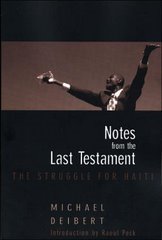
Michael Deibert is a journalist, author and Visiting Fellow at the Centre for Peace and Reconciliation Studies at Coventry University. He is the author of Notes from the Last Testament: The Struggle for Haiti (Seven Stories Press).
Photo © The Above Group
Friday, April 30, 2010
Michael Deibert named Visiting Fellow at the Centre for Peace and Reconciliation Studies at Coventry University
In a very positive development, I have been named a Visiting Fellow at the Centre for Peace and Reconciliation Studies at Coventry University in the United Kingdom. As the Centre's mission is to promote processes of reconciliation and forgiveness by non-violent means at all levels throughout the world, I hope that this role will help to draw attention to Haiti's reconstruction efforts and other issues near to my heart going forward.
Friday, April 16, 2010
Haiti’s peasantry key to reconstruction
Haiti’s peasantry key to reconstruction
By Michael Deibert
AlterNet
(Read the original article here)
When US First Lady Michelle Obama paid a surprise visit to Haiti this week to survey reconstruction efforts after that country’s devastating January earthquake, she set foot in a nation that has been transformed as profoundly as at any time since its 1804 revolution defeated Napoleon's army and abolished slavery.
In the tremor three months ago, Haiti’s Direction de la Protection Civile estimated that 222,517 people lost their lives, while at least 250,000 were injured. Of the nearly 1.2 million displaced persons, nearly 600,000 are thought to have migrated from the capital Port-au-Prince and its environs back to Haiti’s countryside. This reverse migration, after years of peasants flowing into the Haitian capital from desperately poor agricultural areas in search of jobs that did not await them, will likely have a significant affect on Haiti’s political and economic trajectory going forward.
Haiti’s peasantry, which makes up a majority of the country’s 9 million people, were suffering grievously even before the earthquake, the victims of both the short-sighted policies of the international community and the venality and brutality of Haiti’s homegrown political leaders. With a recent meeting on Haiti held at the United Nations concluding with nations and organizations pledging nearly $10 billion to Haiti, it is important that Haiti’s peasantry not be forgotten, and that the international community remember the ways in which it has failed them, and Haitians in general, in the past. It is a litany that would be written as farce had the results not been so tragic.
In the 1940s, the United States sponsored the Société Haitiano-Américaine de Dévelopment Agricole in an ill-fated, half-baked attempted to cultivate rubber in Haiti, an effort that ended up harming the very farmers it was designed to help.
Between 1980 and 1983, when tests showed nearly a quarter of Haiti’s pigs were infected with African Swine Fever, the U.S- Canadian funded Program for the Eradication of Porcine Swine Fever and Development of Pig-Raising destroyed 1.2 million Kreyol pigs, pigs that formed one of the backbones of the peasant economy. Of the replacement pigs that were delivered, many soon died, unable to adjust to the rough world the Kreyol swine had grown so accustomed to, and an already difficult rural economy suffered another blow.
Further undermining Haiti’s ability to feed itself, in typically duplicitous fashion then-Haitian President Jean-Bertrand Aristide, implementing an economic adjustment plan mandated by the International Monetary Fund and further turning the screws on a political bloc that he could never win over, cut tariffs on rice imports to the country from 35 percent to 3 percent in 1995. This further undermined the peasant economy despite the fact that Haiti for many years had produced low-cost, inexpensive rice for domestic consumption. After 1995, that is, after implementing the economic policies of the international community, it effectively lost the ability to do so.
Former President Bill Clinton, still deeply involved in Haiti, has since expressed regret for his role in this, of a piece with his regret for failing to lift a finger to stop Rwanda's 1994 genocide, a “regret” that led him - at best - to turn a blind eye to vicious ethnic cleansing by Rwandan soldiers and Congolese rebels in the Democratic Republic of Congo throughout the 1990s. But this day late, dollar short approach to international affairs will do little good if not followed up with concrete action.
The Haitian government’s Preliminary Damage and Needs Assessment, a document said to have been largely drafted by Prime Minister Jean-Max Bellerive, was put forth in March and advocated an ambitious re-envisioning and decentralizing of Haiti, looking to “decongest,” rather than rebuild as before, the Port-au-Prince metropolitan area while advocating a “refounding” of the Haitian state.
In a country with a long history of an often violently abusive imperial presidency (a tradition that, despite his other faults, current President René Préval has not adhered to), decentralization may be an important tool to break the hold a traditionally corrupt executive branch and dysfunctional political class based in the capital exercise over the rest of the country, active as they have been in filtering out any money that may come into the country while granting precious little in return.
With the mass migration from Port-au-Prince back to Haiti’s countryside, it is essential than any rebuilding effort take into account, along with programs for Haiti’s urban centres, a sustained effort to aid Haiti’s peasantry, who have been in an economic tailspin for decades now and whose migration to Port-au-Prince, where they lived on top of one another in woefully substandard housing, at least in part led to the death toll in January’s earthquake being as high as it was.
Over the past 50 years, 90 percent of Haiti's tree cover has been destroyed, with the resulting erosion destroying two-thirds of the country's arable farmland. With little left to hold the topsoil when the rains fall - often torrentially after prolonged spells with no precipitation at all - they rush in torrents down the mountains, carving gullies and carrying crops and seeds along with them, sweeping vital minerals into the country's rivers to be deposited, uselessly, in the sea. Storms that kill a handful of people in neighboring countries kill thousands when they reach Haiti because of this precise dynamic. I have stood many times with Haitian peasants under the unfurled Caribbean sky outside of villages with names like Fonds-Verettes, Papay and Maissade and listened to Haitian farmers, so powerless in the face of their own government and international interests, tell this sad tale.
But the Haitian peasantry do have their advocates. Grassroots peasant organizations such as the 200,000 member Mouvman Peyizan Nasyonal Kongrè Papay and Tèt Kole Ti Peyizan, the former led by 2005 Goldman Environmental Prize winner Chavannes Jean-Baptiste, have been advocating for decades for Haiti’s rural majority to be taken into account in the discussion of their fate by those politically powerful forces both inside and outside of Haiti.
The patience of Haitians - who have reacted to a terrible catastrophe with incredible dignity and restraint in the three months since the earthquake - is often remarked upon. But it is not, nor should it be be, perceived as endless. It was in Haiti’s countryside, among the peasantry, that leaders such as Charlemagne Péralte and Benoit Batraville led the strongest resistance to the 1915-1935 U.S. military occupation of Haiti and now, with the resources of rural families stretched to the breaking point by the influx of so many new mouths to feed, the international community must, at long last, take their needs into consideration among their glittering conferences and meetings.
Such an approach is not only the morally right thing to do, given the role the international community has had in helping to impoverish Haiti, but it is also the only way to guarantee long-term security and development, not only in Haiti but indeed across the island of Hispaniola as a whole.
Michael Deibert is the author of Notes from the Last Testament: The Struggle for Haiti (Seven Stories Press) and a Visiting Fellow at the the Centre for Peace and Reconciliation Studies at Coventry University. His blog can be read at www.michaeldeibert.blogspot.com.
Subscribe to:
Posts (Atom)